Average Grocery Cost per Month: The 2025 Breakdown

The average grocery cost per month, per person, in the United States is roughly $363 for adults between 19 and 50 years old in a four-person household. This estimation depends on multiple factors, such as the number of people in your household, personal dietary restrictions and shopping habits. By examining these factors, you can better understand grocery costs and how to manage them effectively.
We'll investigate the average grocery prices by household size and different regional areas within the United States, since even your location can significantly impact the price you pay for groceries. Then, we'll dive into tips on reducing your grocery bill with practices such as buying in bulk, managing a shopping list and purchasing food in season.
Factors affecting grocery costs
Factors such as household size, location and habits can affect your home's overall grocery costs. Gleaning insights from this information will allow you to make more informed decisions that could help you save money on your next grocery order. You may not be able to control some factors, such as your location and inflation, but you can calculate your food budget more accurately.
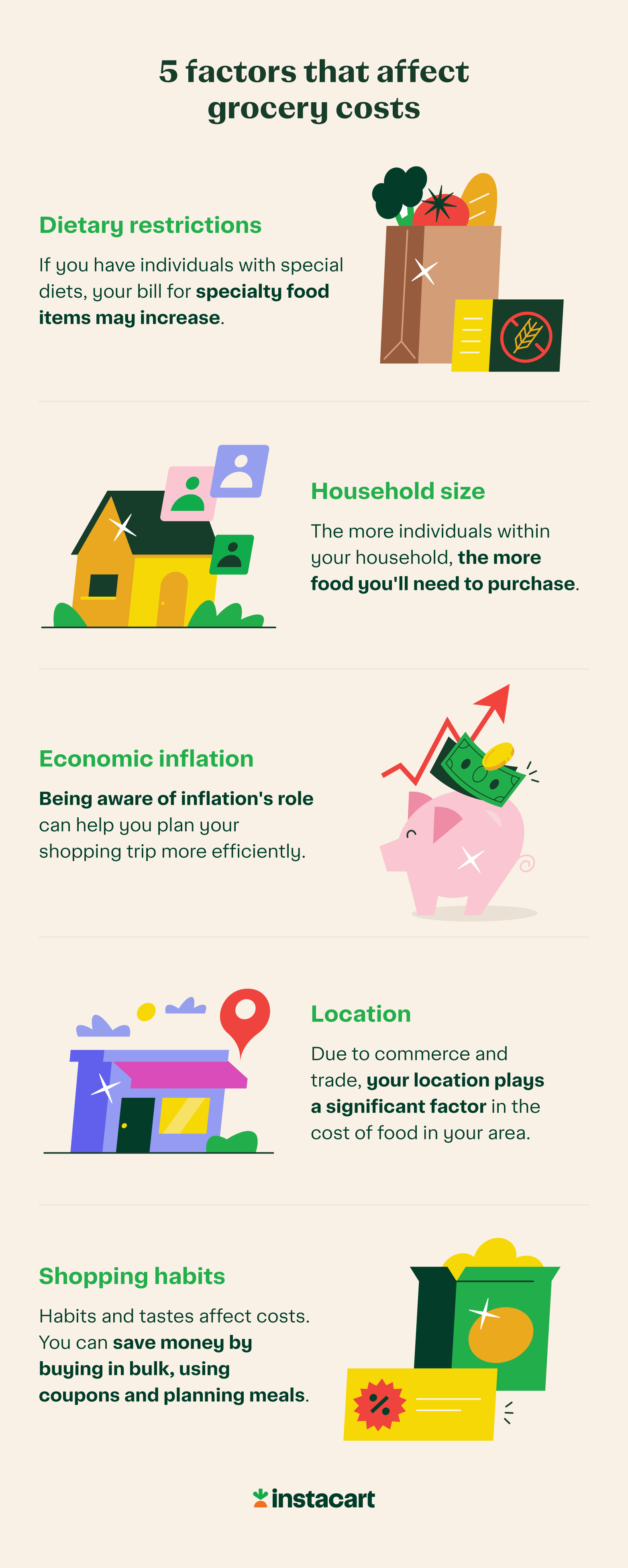
The most common factors affecting grocery costs include:
- Dietary restrictions: If you have individuals with special diets, such as those requiring a vegan grocery list, a keto diet or those with gluten intolerance, your bill for specialty food items will likely increase since those products are typically more expensive.
- Household size: The more individuals within your household, the more food you'll need to purchase and the more money you'll spend on groceries. However buying certain foods in bulk can lead to a lower per-person cost, according to the USDA.
- Inflation: This is a factor you can't control, but being aware of its role and how inflation affects food costs can help you plan your shopping trip more efficiently.
- Location: Due to commerce and trade, your location plays a significant role in the cost of food in your area. For example, rural locations have more direct access to produce, while urban areas tend to have higher labor costs.
- Shopping habits: Habits and personal tastes affect costs. As we'll soon explore, you can save money by buying in bulk, using coupons and planning meals for your family.
Average grocery cost by household size
The average grocery cost by household size will increase with additional household members, so a four-person household will spend more than a two-person household. However, the price per person will decrease due to bulk purchasing and meal sharing — for example, a single adult female may spend $392 on groceries per month, but her cost will decrease to $327 if she is living in a four-person household.
We've assembled five example households for you to compare. According to the U.S. Department of Agriculture, a few essential trends to understand about grocery costs include that, on average:
- Adults are more expensive than children.
- Males are more expensive than females.
- Older adults see a decrease in overall food costs.
The five households are showcased among three different food budgets.
Average grocery cost per month by household size | |||
| Low-cost budget | Moderate budget | Liberal budget |
1 adult male | $371 | $465 | $566 |
1 adult female | $323 | $392 | $499 |
1 adult male, 1 adult female, 1 older child | $881 | $1,104 | $1,345 |
2 adult males, 1 older child, 1 female teenager | $1,142 | $1,426 | $1,725 |
1 adult male, 1 adult female, 1 younger child, 1 older adult | $1,011 | $1,248 | $1,528 |
* Data obtained from USDA Monthly Cost of Food Reports (August 2025)
Regional grocery cost comparisons
The average cost of groceries can change depending on your region. As you move away from locations where food is produced, such as more rural farm areas or cities with packaging plants, the cost of food transport will increase. Living in a more rural or urban area can have food price trade-offs. For example, there is less competition in the country, but a higher cost of living in cities.
Due to the wide variation in pricing, we can't simply say that those living in one area have lower food costs than those living in another. Here are all 50 states and their average monthly food costs based on their most populous city, showcasing the most expensive, least expensive and average options. Find out how your state ranks.
Average grocery cost by U.S. states | ||
Expense ranking | US state | Average cost of groceries |
#1 | Maine | $784 |
#2 | Connecticut | $712 |
#3 | New Hampshire | $704 |
#4 | Hawaii | $690 |
#5 | Massachusetts | $686 |
#6 | New York | $685 |
#7 | Vermont | $680 |
#8 | Alaska | $679 |
#9 | Rhode Island | $678 |
#10 | California | $672 |
#11 | Washington | $665 |
#12 | New Jersey | $662 |
#13 | Maryland | $656 |
#14 | Oregon | $652 |
#15 | Illinois | $649 |
#16 | Colorado | $641 |
#17 | Minnesota | $631 |
#18 | Pennsylvania | $629 |
#19 | Michigan | $627 |
#20 | Nevada | $621 |
#21 | North Dakota | $618 |
#22 | Wisconsin | $614 |
#23 | Delaware | $610 |
#24 | Arizona | $608 |
#25 | Georgia | $607 |
#26 | Utah | $606 |
#27 | South Dakota | $605 |
#28 | Virginia | $604 |
#29 | North Carolina | $603 |
#30 | Florida | $602 |
#31 | Indiana | $601 |
#32 | Montana | $600 |
#33 | Nebraska | $599 |
#34 | Iowa | $597 |
#35 | Arkansas | $595 |
#36 | South Carolina | $594 |
#37 | Kansas | $593 |
#38 | Tennessee | $591 |
#39 | Kentucky | $590 |
#40 | Missouri | $589 |
#41 | New Mexico | $588 |
#42 | Louisiana | $586 |
#43 | Idaho | $584 |
#44 | West Virginia | $583 |
#45 | Texas | $582 |
#46 | Oklahoma | $581 |
#47 | Alabama | $580 |
#48 | Mississippi | $579 |
#49 | Wyoming | $578 |
#50 | Ohio | $577 |
* Data obtained from Numbeo (September 2025)
How to reduce your grocery bill
Reducing the cost of your groceries can feel overwhelming, but don’t fret — we’re here to help you grocery shop on a budget and make your dollar go further. We’ll examine seven money-saving opportunities you have every time you order groceries.
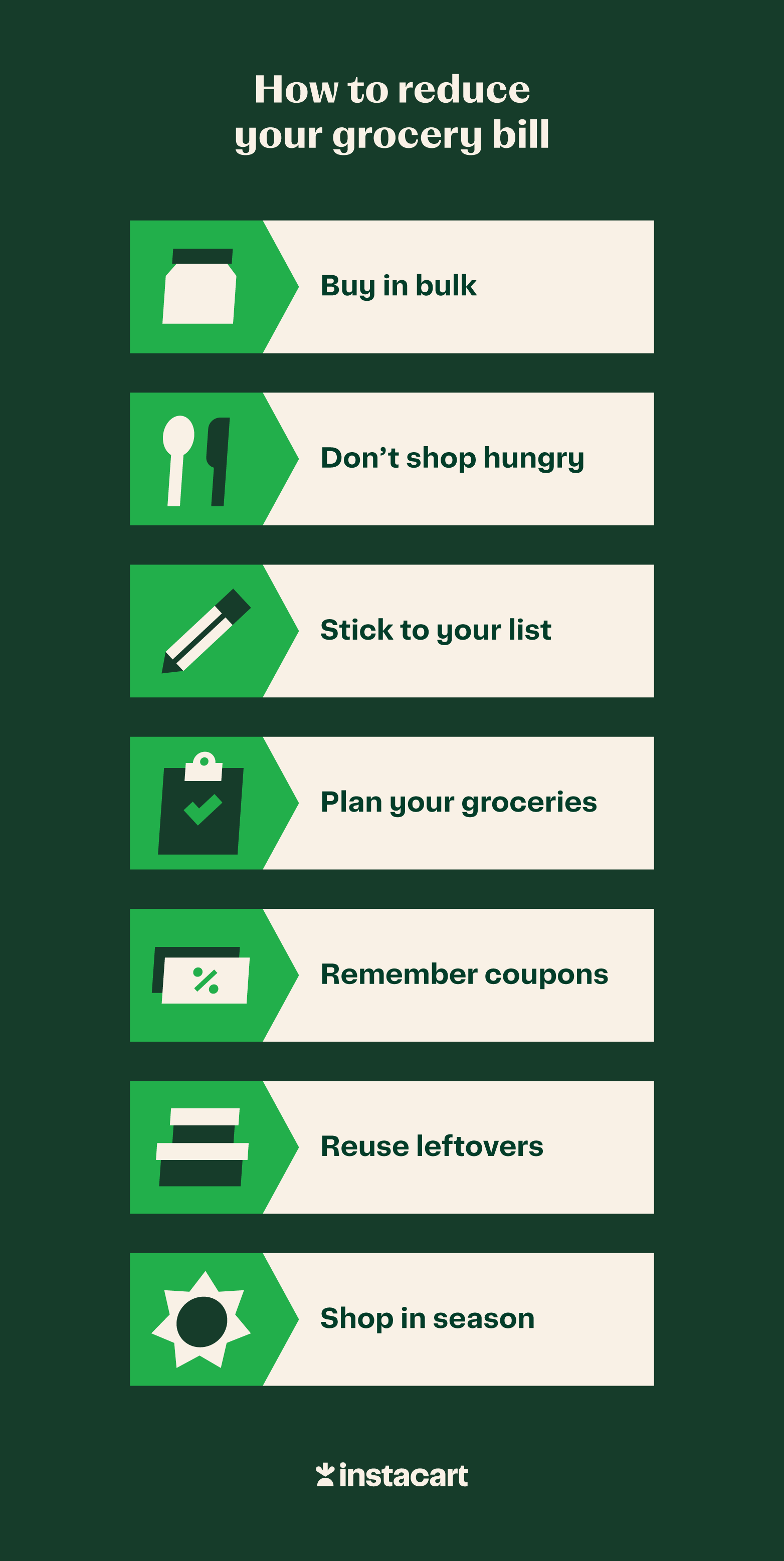
- Buy in bulk: Consider stocking up on items in bulk. Many grocers offer discounts for bulk purchases, a great idea for shelf-stable or freezable items.
- Don't shop hungry: You've heard it before, but don't shop when your stomach growls. You're more likely to buy food you don't need.
- Stick to your list: Instacart lets you view your shopping cart with a tap while putting your order together, helping you know what to get at the grocery store and what you already have in your virtual basket.
- Plan your groceries: By planning your meals and shopping list, you can ensure you only purchase what you need, like for your next packed lunch or weeknight dinner. It’s a great way to eliminate food waste and also useful if you’d like to try vegan recipes or make gluten-free meals for yourself or your family. To get started, check out our free meal planning template for simpler shopping.
- Remember coupons: Coupons are still an excellent way to save money on groceries. You can shop for deals online through Instacart — make sure to visit the Instacart promos and coupons page.
- Reuse those leftovers: You can reduce food costs by eating or repurposing leftover meals before they spoil. Consider batch-cooking large meals for a price-friendly option.
- Shop in season: Purchase foods in season for the best price and the freshest taste. For example, purchase apples in autumn and stone fruits in the summer. Check out these helpful guides for more seasonal shopping ideas:
Grab it now on Instacart


Average grocery cost FAQ
If you have questions about average grocery costs, we’re here to help. Here are answers to our most frequently asked questions:
How much do groceries cost for one person per month?
The cost of groceries for an average person can vary widely depending on their regional location, shopping habits, age, dietary requirements and biological sex. On average, the cost of food for a single adult male with a moderate USDA food budget is $465 a month, while a single adult female is approximately $392.
What is a realistic grocery budget for 2 people?
A realistic monthly grocery budget for two people, one adult male and one adult female, on a moderate food budget would be $785. For two adult males, a realistic budget would be $852; for two adult females, it would be $719.
How much does a family of 4 spend on food?
A family of four that includes one adult male, one adult female and two older children (ages 9 to 11) would spend approximately $1,389 monthly. This estimation is based on a moderate monthly food budget, with the full range starting at $1,100 on a more price-conscious plan and up to $1,675 on a more liberal budget.
What is the average monthly grocery bill for a family of 3?
According to recent data from the USDA, the average monthly grocery bill for a family of three, including one adult male, one adult female and one younger child (ages 4 to 5), would be approximately $974 monthly, based on a moderate food budget. This is an average, and prices may change depending on the members of the family, location, special diets and shopping habits.
Order your groceries through Instacart
The average grocery cost per month can feel like a challenge for families looking to save on their food budget. Shopping through Instacart is effortless and gives you more time to spend with your children and family.
Explore the offers feature within the Instacart app and review the weekly flyer to discover the savings waiting for your next shopping trip. Instacart and select stores also support EBT, allowing individuals to pay for food using their SNAP benefits.

Mel Hull
Author
Mel is a seasoned content strategist and food writer with over a decade of experience helping brands tell compelling stories. Inspired by her hometown of Houston, TX, she brings her love of bold flavors and Southern hospitality to the table. In the kitchen, she loves baking (especially banana bread!) and experimenting with Tex-Mex dishes.

Heather Matley
Editor
Heather Matley is an editor at Instacart whose passion for food and cooking has inspired her work on everything from grocery guides to recipe development. With over eight years of experience in editing, content creation, and search engine optimization, she strives to empower readers with the most effective tools, guides, and ideas to transform their home cooking.

Instacart Recommends
View most recent posts →